
LEADERSHIP OVERVIEW
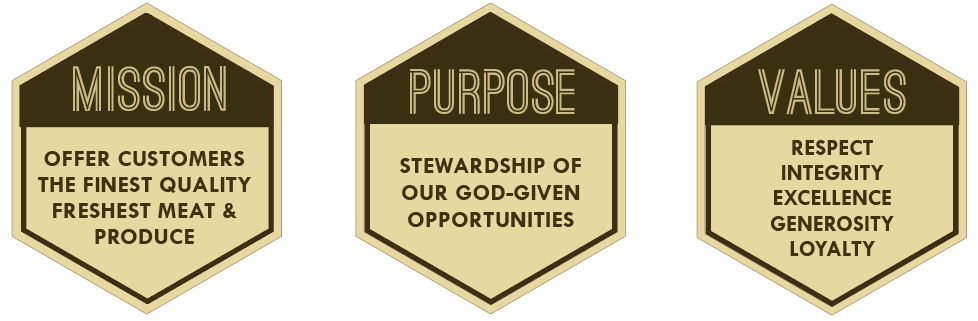
Mission (what we do, and don’t do):
We promise FRESHNESS – every time. Our model is based on the fact that we can deliver Quality and Freshness better than anyone – not convenience, not variety, not the lowest price. We don’t offer packaged foods that can be bought at a better value from Walmart or Amazon.
We are a retail operation, which means we set out to serve end-users: people who use fresh produce and meat to feed themselves and/or their families. We do not strive to serve restaurants, caterers, and other wholesalers or resellers. They are not the end-user, and are not our target customer. If we try to serve them, we risk satisfying one big customer at the expense of hundreds of smaller customers.
Purpose (why we do it):
We’re all here, including the founder of the company, to be good stewards of our opportunities. A steward isn’t an owner, but is responsible for taking care of something that he or she has been entrusted with as if he or she were the owner. We have countless opportunities, or chances, each day. As a leader, you have been identified as someone who’s a good steward of your opportunities. Your job is to ensure that your team does the same – for the good of the company, not the individual.
Values (how we do it):
As a team, we value these things and aim personify them. Each leader has complete control over these traits for themselves, and is expected to exhibit them and require them of their teams:
- Respect: People are important and valuable, so we treat each other as such.
- Integrity: We aim to do the right thing and be people of character, even when nobody else is looking. We believe integrity manifests itself as: candor, honesty, humility, transparency, reliability, and a strong work ethic.
- Excellence: We ask ourselves, “What’s best?” instead of “What’s easiest?” We believe excellence manifests itself as: exceeding expectations, effectiveness, efficiency, proactive problem solving, clear communication, servant leadership, continual improvement, quality, value, doing more with less, and being customer-driven.
- Generosity: We steward resources unselfishly and thoughtfully. Our resources include time, talent, opportunities, and capital. Profits are shared with company leadership.
- Loyalty: We believe voluntary, mutual dedication – across the organization and in all directions – is a natural result of the above values being lived out. As a result, we expect loyalty from our team members and they can expect the same from us as leaders.
Extreme candor: If we’re violating any of these values, we expect you to speak up and start a discussion. Not doing so is, itself, against our values (Integrity).
Extreme stewardship: Our leaders are ultimately responsible for everything and everyone under their care. If a protocol or an individual’s performance is not yielding the desired result, the leader must own that result. He or she must explain the goal, the strategy, and must secure the resources to enable his or her team to succeed.
__________________________________________________________________________
When someone brings you a problem, they are bringing you an opportunity for us to improve. In order to continually improve the quality of our products and service, we use “MR. BID” to help us find factors that diminish the quality of our products and service. Each letter in MR. BID comes from something that can create a problem:
- MISTAKES (inaccurate signage, inaccurate pricing, marquee errors, etc.)
- REWORK (doing something a second time, unnecessarily)
- BREAKDOWNS (in communication, in planning, safety, service, etc.)
- INEFFICIENCY/WASTE (time, labor, product loss, etc.)
- DEVIATIONS FROM PROTOCOLS (production, marquee checking, cleaning, etc.)
Keep Asking Why
We make the most out of the MR. BID by asking 5 Whys to uncover the root cause, or source, of a problem. Asking about 5 times will help us get answers to difficult questions the same way that a child does – by repeatedly asking why. State the problem, ask why it happened, and ask “Why?” as many times as it takes to get beyond the symptoms of a problem and pinpoint its root cause. For example:
Stated problem: Ice Cream sales were down last week.
- Why? Because we ran out of mix.
- Why did we run out? Because the truck was delayed 1 day.
- Why didn’t we have a little safety stock? Because we only order to match weekly movement.
- Why wasn’t the 3 day buffer built into orders? Because the Ice Cream Supervisor was not trained properly.
- Why? Because keeping 3 days of safety stock was discussed, but the director never added to our training document – AHA!
Fix the system, Don’t Point Fingers
Bringing a problem forward is only half of the equation. Once the team is aware of a problem, we must work to correct it. This is a tricky because it sometimes leads to finger-pointing, passing the buck, or circular blame. It’s easy to say we want to improve quality. It takes discipline and humility to be candid about mistakes and work together to improve systems to prevent them from happening again.
When Bad News is Bad News
As a leader, you must set the expectation that problems are brought to you – not hidden (discovered by you). A problem brought forward along with a proposed solution deserves praise. A problem that has been overlooked or swept under the rug deserves correction. Even then, it’s a learning opportunity for the individual or team responsible for it.
To summarize, we need a culture of open discussion and resolution of process problems. Uncovering a problem or a mistake creates an opportunity to improve our processes and controls. It’s important that all team members report breakdowns so that we can build solutions that improve quality instead of overlooking problems or avoiding conflict. Reporting problems is a required part of employees’ job descriptions. This helps create an environment in which breakdowns and inefficiencies can be openly discussed without people feeling defensive. Our goal is to trace all failures down to a single-point-of-failure in a process, not a person.